Monday, February 16, 2015

with music (tanka)


with music
he parts the mists in my heart –
i am at peace


the lions of judgment
will have to wait in silence 


Henri Rousseau. The Dream.


Inspired by Henri Rousseau’s “The Dream”. 

Rousseau wrote a poem to accompany his artwork:

Yadwigha in a beautiful dream 
Having fallen gently to sleep 
Heard the sounds of a reed instrument 
Played by a well-intentioned [snake] charmer. 
As the moon reflected 
On the rivers [or flowers], the verdant trees,  
The wild snakes lend an ear 
To the joyous tunes of the instrument.

The name “Yadwigha” reminded me of Jadwiga of Poland. Some research on Wikipedia revealed that the woman in the painting is a Polish mistress from Rousseau’s youth.  And since I was raised in a part of the world where being Polish makes one the butt of many jokes — knowing that this lovely lady is YADWIGHA makes my heart happy in about twenty different ways. 


Saturday, January 31, 2015

in the thicket (haiku)


in the thicket
what do chipmunks dream
while vacationing?


 **

Inspired by Yabu-iri (Servant’s Day or “thicket entering”) - an obscure season marker for spring or late New Year. 

“On or about the sixteenth of the first month, servants and apprentices were allowed to go home for a short visit. This would have meant that the holiday started with the full moon.”
So, in Issa’s haiku:

ending the Servant’s Holiday
on purpose ...
sliver moon

“The final slip of moon means the holiday is over, which tells us it lasted less than two weeks (Lanoue, 1991-2009: moon, 1803).  There also was a second servants’ holiday on the sixteenth of the sixth or seventh month, but yabu-iri in haiku was codified as an early spring kigo (or late New Year kigo).”  (Source)

Apprentices also had a “servant’s holiday”:

apprentice’s holiday:
a good-luck amulet
forgotten in the grass

Buson


**

If I recall correctly, “thicket-entering” is sort of like saying the servants were headed home “in the sticks” or “in the boonies” as we would say here in the U.S.    

Here are a slew of Issa haiku about the servants.

**

Neat fact of the day:  “chipmunk” comes from the Ojibwe word “ajidamoo” (one who descends trees headlong).  They don’t really hibernate – they enter a state of deep torpor.  I can hardly wait for our friendly neighborhood chipmunk “Boxcar Willie” to return from his “long winter’s nap”!

******

Thursday, January 29, 2015

aware (haiku)

Source

**

aware –

she nudges her dream

in a lucky direction 


**

Inspired by Hatsuyume, the first dream of the year.


"Hatsuyume was extremely important because it would foretell the dreamer’s luck for the upcoming year.  “In Japan, the night of December 31 was often passed without sleeping, thus the hatsuyume was often the dream seen the night of January 1. This explains why January 2 (the day after the night of the "first dream") is known as Hatsuyume in the traditional Japanese calendar.”


Source


**

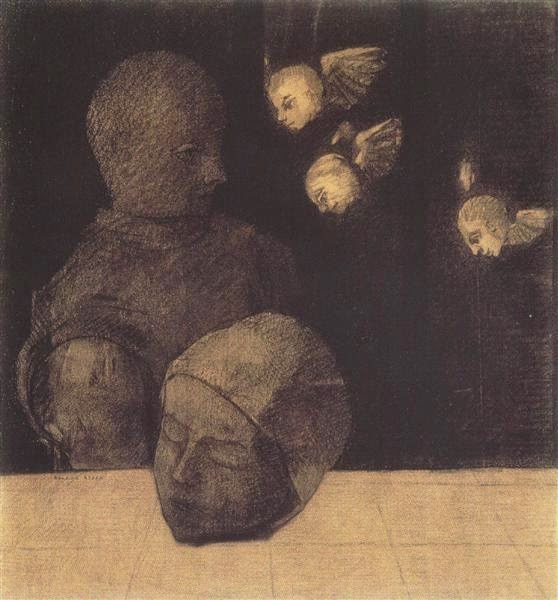
Original: Odilon Redon

**